Recycled London: Recycling and Sustainability
 Recycled London is committed to transforming how the city handles waste, reuse and resource recovery. In a dense urban environment every kilogram saved from landfill matters. Our London-focused recycling program aims to be pragmatic and ambitious: we have set a clear recycling percentage target of 65% household and commercial recycling by 2030, with interim milestones to track progress. This target underpins all our operational changes, community partnerships and fleet investments.
Working across borough boundaries, the Recycled London initiatives coordinate with councils and local waste authorities to align with each borough's approach to waste separation. Many boroughs now separate food waste, mixed dry recyclables, glass and residual waste; others run communal schemes for textiles and bulky items. We respect these local systems while offering value by improving collection logistics,, expanding reuse paths and diverting more material into the circular economy.
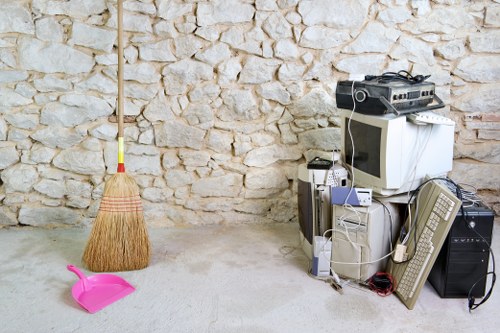 Our sustainability strategy covers the full journey of material: from kerbside and bring-site collections through local transfer stations to reuse and recovery. We operate with a network of local transfer stations sited to reduce haul distances across London boroughs — supporting more efficient routes in Enfield, Hackney, Croydon and surrounding areas — and ensuring materials are consolidated close to where they’re collected. These transfer hubs are critical to cutting emissions and increasing the volume of properly sorted recyclables sent on for processing.
Central to Recycled London's mission is partnering with charities and social enterprises that give items a second life. We have active partnerships with community reuse centres, furniture and textiles charities, and local food redistribution groups. By redirecting reusable goods through charity partners rather than sending them to MRFs or landfill we deliver greater social and environmental impact: items are repaired, resold, or redistributed to people in need.
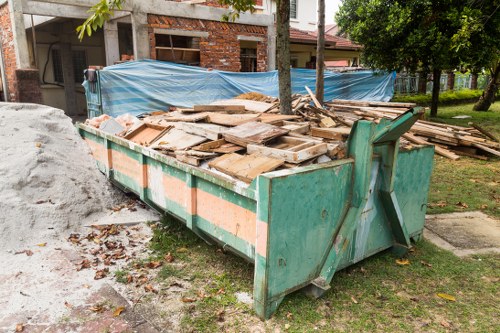 Our charity partnerships include collaboration on large-item collections and coordinated drop-off points that make donation easier for residents. We provide logistics support so that donated furniture, working electronics and usable household goods are taken directly to local not-for-profits. This reduces handling, minimizes contamination, and increases reuse rates — a practical example of how London reuse and recycling works hand-in-hand.
We also invest in education and behaviour programmes that support borough-level waste separation rules: clear labelling of bins, targeted campaigns about food recycling and composting, and community repair sessions. Key operational principles include:
- Reduction first — promoting reuse, repair and refill schemes.
- Reuse second — routing usable items to charity partners.
- Recycle third — improving separation and material recovery.
Fleet and transport are major contributors to city emissions. To cut carbon from collections, Recycled London has deployed a growing fleet of low-carbon vans and electric delivery vehicles. We have replaced a portion of diesel vehicles with electric vans and are rolling out higher-capacity battery electric vehicles and plug-in hybrids for transfer operations. The shift reduces urban pollution and supports boroughs’ clean air objectives.
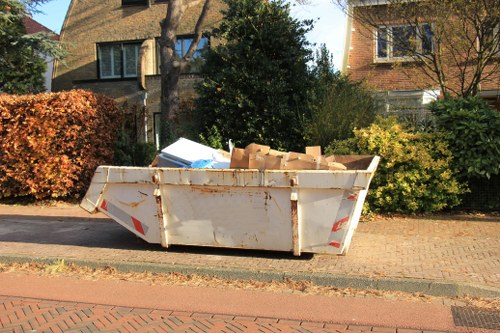 In addition to battery electric vans, we use cargo bikes and small electric vans for last-mile collection in narrow streets and low-traffic neighbourhoods, a hallmark of efficient recycling in London. These low-emission vehicles allow us to serve inner-city areas where access and congestion are constant challenges. Reducing mileage to transfer stations and optimizing load planning further reduces the carbon footprint of each tonne collected.
![The image depicts a cluttered storage area filled with various household and garden items. In the foreground, there is a blue bicycle leaning against a wooden shelving unit that holds multiple black and red storage boxes and plastic containers. To the left, a large brown terracotta plant pot sits on the floor alongside several smaller empty pots, some stacked. Near the pots, a yellow plastic container and a green garden hose are coiled and arranged on the ground. On the left side of the image, a black filing cabinet with several drawers is visible, with additional boxes and bags stored on top of it and on the metal shelving above. The shelves are filled with a mix of items, including plastic bins, bags, gardening equipment, and miscellaneous tools, with some cords and hoses draped over the items for organization. The background contains more storage boxes and miscellaneous objects, indicating a utilitarian space, likely used for household or garden rubbish and equipment storage. The environment appears well-used but organized, typical of a garage or shed used by Recycled London for rubbish management in the local vicinity of [POSTCODE] or [TOWN], reflecting a common scene for waste collection and storage.](/pub/_photos/rubbish/f1501692464.jpg) Transparency is important: we publish progress reports against our recycling target and disclose fleet emissions reductions as part of our sustainability commitments. We work with third-party auditors and borough partners to validate diversion rates and measure the impact of charity reuse channels, local transfer station efficiencies, and low-carbon transport solutions. Our combined approach improves outcomes for materials ranging from paper, cardboard and mixed plastics to glass, metals, textiles and food waste.
Transparency is important: we publish progress reports against our recycling target and disclose fleet emissions reductions as part of our sustainability commitments. We work with third-party auditors and borough partners to validate diversion rates and measure the impact of charity reuse channels, local transfer station efficiencies, and low-carbon transport solutions. Our combined approach improves outcomes for materials ranging from paper, cardboard and mixed plastics to glass, metals, textiles and food waste.
Innovation is also part of our plan. We trial technologies at local transfer stations to improve sorting accuracy and support borough MRFs with expressed needs such as glass cleaning systems and separate food-waste logistics. Where boroughs operate alternate-week collections or have specific food waste schemes, we align our services to streamline collections and reduce cross-contamination.
Our team recognises that successful recycling in London requires cooperation across municipal services, charities, social enterprises and residents. By combining a clear recycling percentage target, practical use of local transfer stations, strong partnerships with charities, and a transition to low-carbon vans, Recycled London aims to make measurable progress toward a circular, low-carbon, socially responsible waste system for the city.
We continue to refine routes, expand charity networks and invest in greener vehicles so that every borough can benefit from smarter, cleaner and more inclusive recycling. Recycled London is more than a service — it is a city-wide effort to keep materials in use, reduce emissions and support communities through sustainable reuse.